Absolute Asia/Destinations/South Korea/Places to Visit/Gyeongju, South Korea: Silla’s Royal Capital, Bulguksa, Seokguram and Wolji Pond
Private & Tailor-Made South Korea Tours
The museum without walls: a thousand years of Silla kings
The Essence of Gyeongju, South Korea
Gyeongju was the capital of the Silla kingdom from 57 BC to AD 935. Its Historic Areas and the Bulguksa and Seokguram sites are UNESCO World Heritage Sites.
Gyeongju was the capital of the Silla kingdom for nearly a thousand years, from 57 BC to AD 935, and the city still looks like it: grassy burial mounds the size of hills sit between modern streets, and temples, pavilions and royal ponds are scattered across the plain and the mountains around it. It’s often described as a museum without walls. It’s the best place in South Korea to see the country’s ancient past, and an easy trip from Seoul or Busan.
| Silla capital | 57 BC to AD 935 |
|---|---|
| Historic Areas | UNESCO, December 2000 |
| Bulguksa and Seokguram | UNESCO, 1995 |
| Cheomseongdae | 9.4 m, 27 tiers, National Treasure No. 31 |
| Wolji Pond | dug 674, renamed from Anapji in 2011 |
The Gyeongju Historic Areas
UNESCO listed the Gyeongju Historic Areas in December 2000. They cover five districts: Wolseong (the site of the royal palace), Hwangnyongsa (a great temple site), Sanseong (a mountain fortress), Namsan (a mountain of Buddhist carvings) and Daereungwon (the royal tombs). Korean sources note that the density and variety of the remains compare well with the heritage sites of Kyoto and Nara.
Bulguksa and Seokguram
Bulguksa is a hillside temple on Mount Toham, listed by UNESCO in 1995 together with the Seokguram grotto. Temple records say it was founded in 528 and was greatly expanded in 751 by the minister Kim Daeseong, according to the Korean accounts, and its stone bridges, pagodas and terraces are among the most admired Buddhist architecture in Korea. Entry was made free from May 2023, according to Korean sources, but check the current rule and the parking fee before you go.
Seokguram sits higher on the same mountain. It’s a granite cave temple, begun in 751 and finished in 774, and Korean sources describe it as the only man-made granite grotto in the world. It holds a seated Buddha, and photography is not permitted inside. Many visitors combine Seokguram and Bulguksa in a morning.
Cheomseongdae
Cheomseongdae is a small bottle-shaped tower of 27 courses of stone, about 9.4 meters tall, built during the reign of Queen Seondeok. It was named a National Treasure in 1962 and is traditionally considered the oldest surviving astronomical observatory in Asia, although scholars still debate what it was used for. It’s only a few minutes’ walk from the tombs.
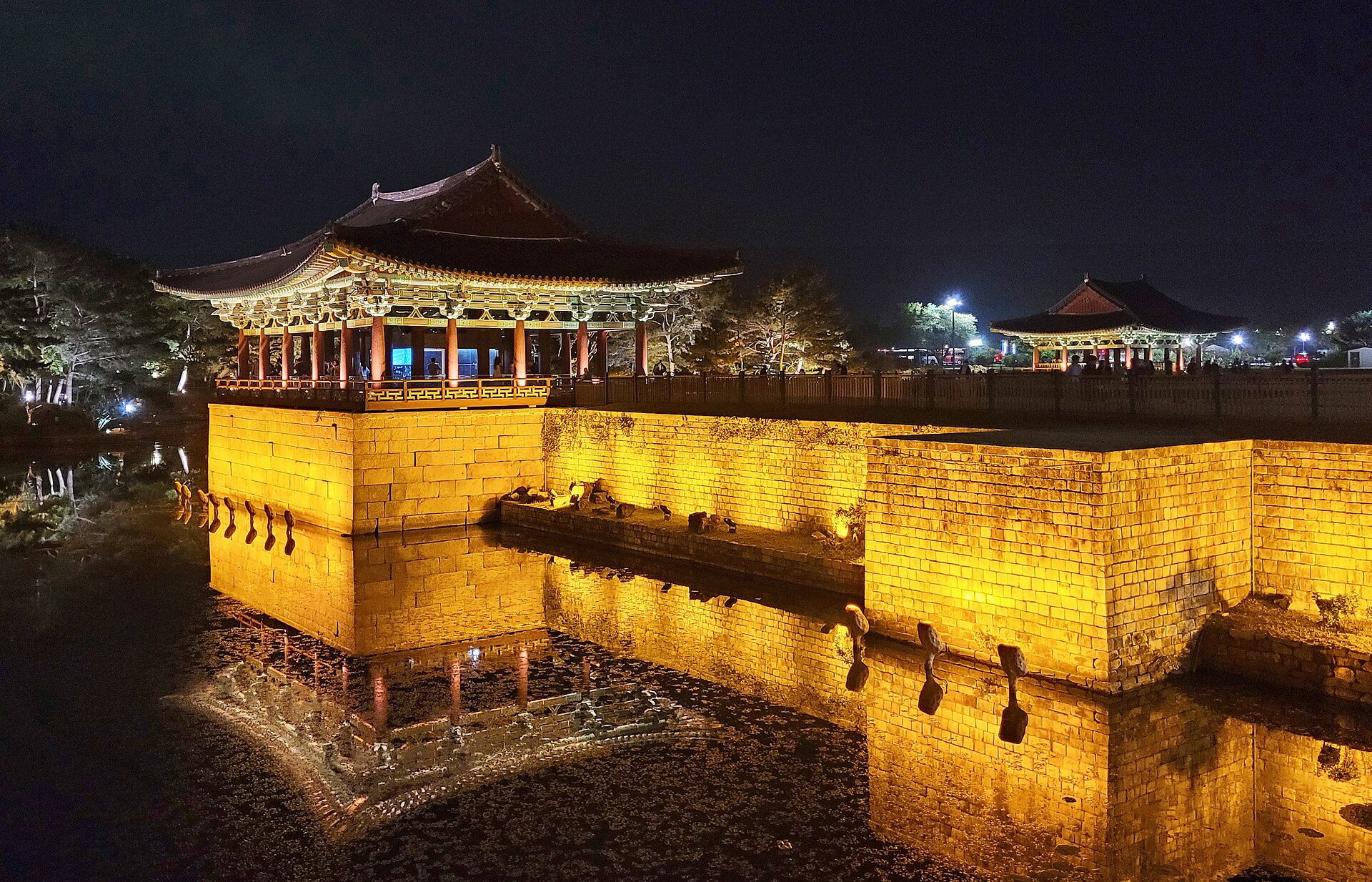
Wolji Pond at night
Donggung Palace and Wolji Pond were the prince’s palace and pleasure garden of the Silla royal court. In 674 King Munmu had a large pond dug, with three islands in it, and the court held banquets here. After Silla fell in 935 the pond was neglected, and in the Joseon era visitors named it Anapji, “the pond of geese and ducks.” Excavations in 1980 showed that its Silla name was Wolji, and it was officially renamed in 2011. The pavilions are lit at night and reflected in the water, and it’s the single best reason to stay overnight in Gyeongju.
The royal tombs at Daereungwon
In the middle of town, Daereungwon is a park of grass-covered royal tombs, some very large. The gold crown found at Geumgwanchong, a tomb in the Noseo-dong group, was discovered in 1921, and finds from the tombs are displayed at the National Museum in Gyeongju. Walk through the park to see how large the mounds are up close.
Getting there and how long to stay
Gyeongju is reached by high-speed train and then a local bus or taxi, or by road from Busan, which is the nearest large city. Stay two nights if you can: one day for Bulguksa and Seokguram, and one for the tombs, the pond and Namsan. See our guides to Busan and Seoul, South Korea tour packages, and our guides to autumn in South Korea and winter in South Korea.
Planning Gyeongju with Absolute Asia Tours
Absolute Asia Tours has planned private trips in Asia since 1989. For Gyeongju that means a private guide who can read the Silla story into the mounds and ruins, a driver between the temple, the tombs and the pond, and a hotel close to Wolji for the evening. We’re rated 4.8 out of 5 across about 900 traveler reviews. Have a look at our South Korea tours or tell us your dates.
Sources (read in Korean, Korean Wikipedia): 경주시, 불국사, 석굴암, 첨성대, 동궁과 월지. Last checked November 2026.
Gyeongju: FAQ
What is Gyeongju known for?
It was the capital of the Silla kingdom, and it has two UNESCO World Heritage Sites: the Historic Areas and the Bulguksa and Seokguram sites.
How many days do you need in Gyeongju?
Two days. One for Bulguksa and Seokguram, one for the tombs, Cheomseongdae, Wolji and Namsan.
How do you get to Gyeongju from Seoul?
By high-speed train to the Gyeongju area, then a bus or taxi into town.
Can you take photos inside Seokguram?
No. Photography is not allowed inside the grotto.
What is Cheomseongdae?
A 9.4-meter stone tower from the Silla period, traditionally considered Asia’s oldest surviving observatory.
What is the best time to visit Gyeongju?
Spring and autumn, but the city is also quieter in winter. Check the evening lighting hours at Wolji before you plan around them.
Photo: Bernard Gagnon, Wikimedia Commons, CC0.

The Private Difference
Tailor-Made Gyeongju, South Korea Journeys
Absolute Asia crafts completely tailor-made, 100% private luxury journeys across South Korea. Guided by certified English-speaking scholar specialists, experience private after-hours access to Changdeokgung's Secret Garden, private hanbok fittings in Bukchon, high-speed KTX First Class rail to the ancient Silla capital of Gyeongju and coastal Busan, and stays at premier properties including Four Seasons Hotel Seoul and Signiel Busan.
Destination Quick Facts
| Ideal Duration | 7 – 12 Days (or 14 – 18 Days combined with Japan) |
| Best Season | Apr – May (Cherry Blossom Season & Mild Spring), Sep – Nov (Crisp Skies & Spectacular Autumn Foliage) |
| Typical Budget | $550 – $1,200+ per guest / day (Private executive vehicle & chauffeur, KTX First Class, certified bilingual guide, 5-star luxury hotels & domestic flights) |
| Travel Style | 100% Private, Tailor-Made Cultural Immersion & Contemporary Luxury |
| Best For | UNESCO Royal Palaces & Hanok Villages, Haute Korean Gastronomy & Michelin Dining, High-Speed KTX Rail, Contemporary Art & Architecture, Coastal Temples & Volcanic Jeju |
Our Favorite Journeys
Gyeongju, South Korea, at Its Best Right Now
We are composing new Gyeongju, South Korea itineraries right now. Tell us what you have in mind and a designer will build one around you.
Transparent Pricing Intelligence
What Does a Private Gyeongju, South Korea Tour Cost?
South Korea combines ultra-modern infrastructure with deep dynastic traditions. Every Absolute Asia journey includes dedicated private executive vehicles and chauffeurs, KTX First Class bullet-train seating with luggage forwarding, licensed bilingual cultural guides, curated royal dining, and vetted 5-star luxury accommodations.
$550 – $750 per guest / day
Premier 5-star international hotels (The Shilla Seoul, Grand Josun Busan), private chauffeured touring, KTX First Class bullet-train tickets, licensed English-speaking guide, and curated palace admissions.
- 5-star luxury city and beach hotels
- Dedicated private executive sedan or minivan and chauffeur
- Licensed bilingual cultural guide throughout touring days
- Reserved KTX First Class bullet-train tickets between cities
- All curated palace admissions, hanbok experience & tea tastings
$800 – $1,350 per guest / day
World-class properties (Four Seasons Hotel Seoul, Signiel Busan) combined with authentic luxury hanok suites (Rakkojae Bukchon), private royal court dinner prepared by an intangible cultural heritage chef, and private DMZ tour.
- Luxury suites at Four Seasons Seoul and Signiel Busan
- Exclusive private hanok stay with cypress baths and traditional ondol heating
- Private VIP Korean culinary masterclass with a master chef
- Private chauffeured touring of the DMZ with exclusive access permissions
- 24/7 dedicated bilingual travel concierge & airport fast-track
$1,450 – $2,600+ per guest / day
The pinnacle of Korean luxury: Presidential suites, JW Marriott Jeju Resort & Spa clifftop villas, private helicopter volcano tours, after-hours private viewing of UNESCO royal tombs, and Michelin 3-star culinary dining.
- Top-tier executive suites and clifftop private villas in Jeju
- Private helicopter transfers and coastal aerial touring
- Private opening of National Treasure temple halls with resident Buddhist monks
- Private yacht charters on Haeundae Bay in Busan
- Unrestricted bespoke dining reservations and private sommelier pairings
What Drives Your Total Investment?
- Peak spring sakura (early April) and autumn foliage (October–November) hotel demand
- Boutique luxury hanok residences have very few rooms (3–5 suites per property)
- Dedicated private executive Mercedes van vs KTX high-speed rail combinations
- Flight hops to Jeju Island (Gimpo to Jeju GMP ⇄ CJU) during holiday periods
Local Operational Realities
What You Need to Know Before Traveling in Gyeongju, South Korea
KTX High-Speed Bullet Rail & Door-to-Door Luggage Courier
South Korea's KTX bullet train network connects Seoul to Gyeongju in 2 hours and Busan in 2.5 hours at speeds exceeding 300 km/h. To ensure seamless comfort, Absolute Asia coordinates luggage forwarding between city hotels so you board KTX First Class with only daypacks.
Hanok Heritage Living vs. Modern 5-Star Luxury
Traditional Korean hanok homes feature low furniture, paper screen doors, and ondol (underfloor heating). While deeply atmospheric, staying exclusively in hanoks for a whole week can feel rustic. Absolute Asia recommends pairing 1–2 nights in a restored luxury hanok (like Rakkojae) with modern 5-star sanctuaries (Four Seasons Seoul).
Seoul Urban District Pacing & Chauffeur Logistics
Seoul is a massive metropolis divided by the Han River. Transit between northern historical districts (Jongno, Bukchon, Insa-dong) and southern modern hubs (Gangnam, Apgujeong) can be slow during peak traffic. Absolute Asia sequences touring by geographic clusters, maximizing time spent exploring rather than sitting in traffic.
Dining Customs & Dietary Accommodations
Traditional Korean meals emphasize shared banchan dishes, barbecued meats, and broths prepared with garlic, fermented paste, and anchovy stock. Our private concierges coordinate dietary restrictions with chefs in advance to accommodate vegetarian, gluten-free, or pescatarian preferences without sacrificing authentic flavors.
Handpicked 5-Star Sanctuaries
Signature Stays & Exclusive Experiences in Gyeongju, South Korea
Four Seasons Hotel Seoul
Contemporary Korean luxury overlooking Gyeongbokgung Palace, featuring an authentic Korean bathhouse, Michelin dining, and the Charles H. speakeasy.
Signiel Seoul
Perched between floors 76 and 101 of the landmark tower, offering panoramic skyline vistas over Seoul and the Han River, with Michelin-starred dining.
Signiel Busan
Luxury oceanfront suites in the LCT Tower overlooking Haeundae Beach, featuring outdoor infinity pools, private cabanas, and retreat spa sanctuaries.
Rakkojae Seoul Bukchon
A 130-year-old aristocratic hanok residence restored by a human national treasure, featuring traditional wooden architecture, mud saunas, and private tea pavilions.
JW Marriott Jeju Resort & Spa
Bill Bensley-designed clifftop sanctuary blending Jeju volcanic stone with modern luxury, overlooking the dramatic southern coast and Olle trails.
The Shilla Seoul
Distinguished Korean grande dame featuring traditional sculpture gardens, the 3-Michelin-star Korean restaurant La Yeon, and Urban Island pool cabanas.
Tailored to Your Style
Family & Honeymoon Journeys in Gyeongju, South Korea
Private South Korea Family Adventures
An exciting, high-energy journey for families: explore Gyeongbokgung Palace dressed in bespoke royal hanbok, learn choreographed dance moves in a private K-pop studio, ride 300 km/h KTX bullet trains to Busan, walk across the glass sky bridge 500 meters up Lotte World Tower, and explore ancient royal burial mounds in Gyeongju.
- Private hanbok fitting and photographer-escorted exploration of royal Joseon palaces
- Interactive K-pop dance and vocal masterclass with professional entertainment trainers
- High-speed KTX First Class bullet-train rides across the Korean peninsula
- Private hands-on kimchi making and Korean barbecue culinary masterclasses
- Family-friendly coastal yacht cruises and beach fun along Busan's Haeundae shoreline
Romantic Korea & Jeju Island Escapes
An intimate, sophisticated romantic getaway: stay in a private luxury hanok with traditional cypress hot tubs, take part in an exclusive tea ceremony in Bukchon, enjoy private sunset champagne cruises along Busan's illuminated Diamond Bridge, and retreat to a secluded private pool villa on volcanic Jeju Island.
- Exclusive private hanok suite stays with traditional ondol comfort and wooden courtyards
- Couples' Korean traditional spa rituals featuring red ginseng, jade stone, and hydrotherapy
- Private candlelit dinners at Michelin-starred Korean contemporary dining rooms
- Private sunset yacht charters on Haeundae Bay with champagne and coastal vistas
- 24/7 dedicated private chauffeur and concierge managing all reservations and VIP entries
Cross-Border Extensions
Seamless Multi-Country Extensions Beyond Gyeongju, South Korea
Connect multiple Asian cultures into one coherent private journey with expert in-country concierge coordination.
Japan & South Korea: East Asia Cultural Icons
Tokyo → Hakone → Kyoto → Osaka → Seoul → Busan
Short 2-hour non-stop flight connecting Osaka Kansai (KIX) or Tokyo Haneda (HND) to Seoul Incheon (ICN) / Gimpo (GMP).
When to Go
The premier seasons to visit South Korea are spring (April to May) for the cherry blossoms and pleasant spring warmth, and autumn (September to November) for crisp blue skies, low rainfall, and breathtaking autumn colors across national parks and palaces.
Winter (December to February) is crisp and snowy, ideal for hot stews, Korean saunas (jjimjilbang), and quiet palace strolls.
Month by Month
South Korea Through the Seasons
Cherry Blossom Spring (Beotkkot)
Delicate pink blossoms across Yeouido and Gyeongju; pleasant mild weather perfect for palace gardens and outdoor walks.
Summer Energy & Coastal Busan
Lush green mountains, vibrant summer beach festivals in Busan, and refreshing coastal breezes on Jeju Island.
Crisp Autumn Foliage (Danpung)
Spectacular crimson maples and golden gingko trees across Seoul palaces, Gyeongju tumuli, and Mount Seorak.
Winter Dynasties & Warm Saunas
Crisp winter skies, snow-covered royal roofs, steaming Korean bathhouse rituals, and quiet cultural touring.
Frequently Asked Questions
Private Travel to Gyeongju, South Korea: Essential Advice
Verified Traveler Stories
Recent Guest Experiences in Gyeongju, South Korea
“Our private tour through Seoul, Gyeongju, and Busan with Absolute Asia was flawless. Our guide, Min-jun, brought Korean royal history to life at Gyeongbokgung and took us to private artisan studios in Bukchon that we never would have discovered alone. Four Seasons Seoul and Signiel Busan were both magnificent.”
“Combining the high-speed KTX train with luggage forwarding was a masterstroke—we traveled so easily between Seoul and Busan. The private street food tour in Gwangjang Market and our stay at Rakkojae hanok were the highlights of our East Asia trip.”
Start Planning
Ready to see Gyeongju, South Korea on your own terms?
Share a few details and a private travel designer will reach out within one business day.