Absolute Asia/Destinations/South Korea/Places to Visit/Busan City Guide: Beaches, Gamcheon Village, Jagalchi Market and a Seaside Temple
Private & Tailor-Made South Korea Tours
Korea's port city, with beaches, hillside murals and a fish market
The Essence of Busan City Guide
Busan is South Korea's second-largest city and its biggest port. Beaches, a mural village built by refugees, a famous fish market and a seaside temple are all within one city.
Busan is South Korea’s second-largest city and its biggest port, a long strip of beaches, hills and harbor at the country’s southeast corner. It feels more relaxed than Seoul, and the sights are a mix of the seaside, the street art and the food. It’s an easy add-on to a Seoul trip, and it works as a stopover on the way to Jeju.
| Treaty port | opened 1876 |
|---|---|
| Haeundae Beach | about 1.5 km long, swimming season early June to end of September |
| Gwangalli Beach | about 1.4 km long |
| Gamcheon | settled in the 1950s, mural project from 2009 |
| Rank | South Korea’s second-largest city and largest port |
A port city
Busan opened as a treaty port in 1876, one of the first three in Korea, along with Incheon and Wonsan. During the Korean War it was the country’s temporary capital and a refuge for people from across the peninsula, and that history shapes the city today. It hosted the 2002 Asian Games and the 2005 APEC summit, and it’s home to the Busan International Film Festival.
Haeundae and Gwangalli beaches
Haeundae is the best-known beach in Korea. It’s about 1.5 kilometers long and 30 to 50 meters wide, with hundreds of hotels and restaurants behind it, and its swimming season officially runs from early June to the end of September. Dongbaek Island, a short walk along the shore from the beach, has a path through camellia trees and the Nurimaru, the building that hosted the 2005 APEC summit.
Gwangalli is a smaller, quieter beach to the southwest, about 1.4 kilometers long, with cafes along the promenade and a view of the Gwangan Bridge, which is lit with colored LEDs after dark. The Busan fireworks festival is held here and draws crowds of more than a million.
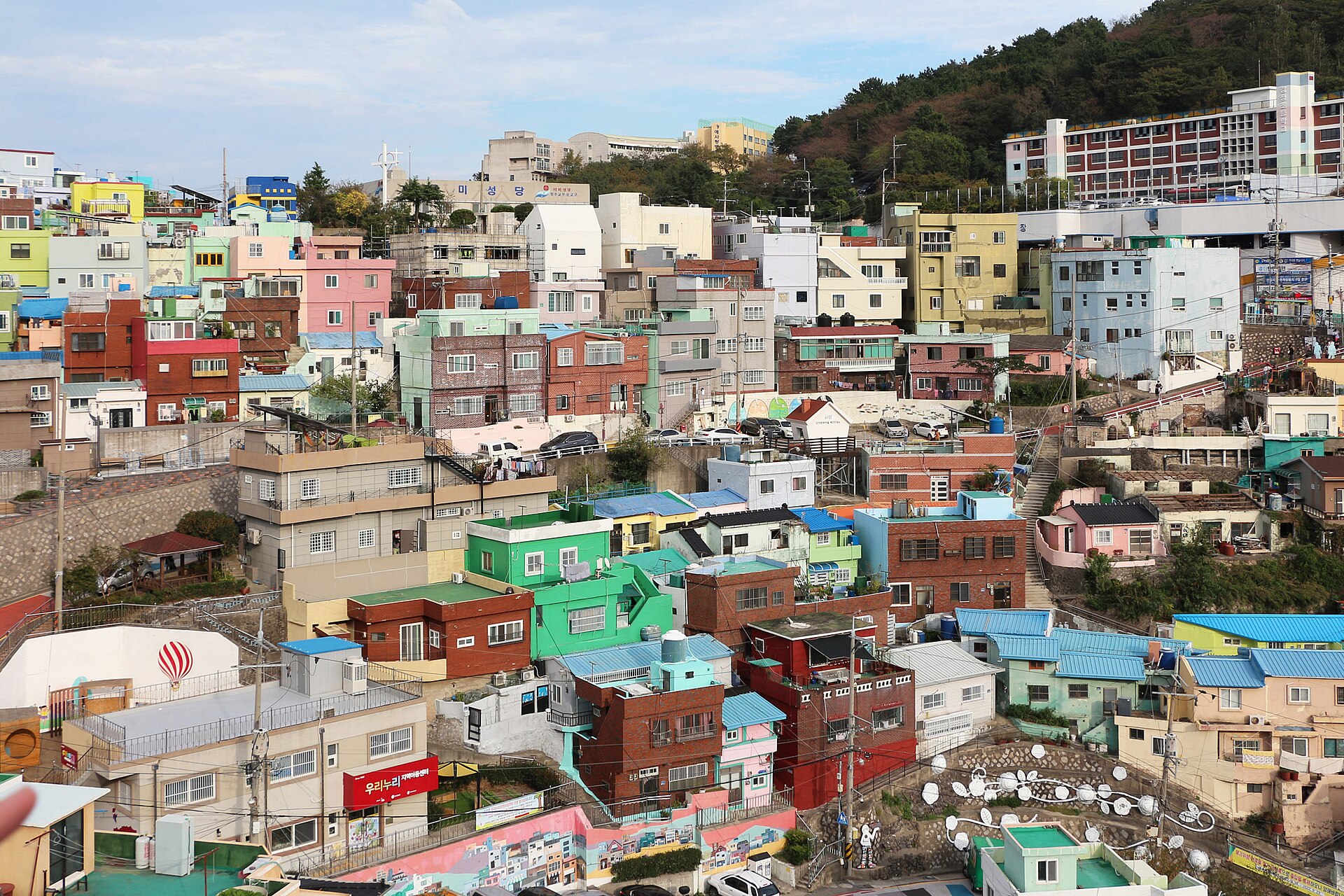
Gamcheon Culture Village
On a steep hillside in the Saha district, Gamcheon was settled in the 1950s by followers of the Taegukdo religion and by Korean War refugees. In 2009 local artists and residents began painting murals on walls and houses as part of a regeneration project, and the village was designated a culture village in 2010. It’s now one of the most photographed places in the city. Residents still live here, so keep to the marked routes and keep your voice down.
Jagalchi Market
Jagalchi is Korea’s best-known fish market, beside Nam Port in the old city center. The market area stretches from the dried-fish stalls near Yeongdo Bridge to the early-morning market in Chungmu-dong. Go in the morning to watch the trade, then eat at one of the restaurants upstairs or nearby, where you can choose live seafood and have it prepared.
Haedong Yonggungsa
Few Korean temples sit directly on the sea. Haedong Yonggungsa, on the coast of Gijang county, east of the city center, is one of them, with its halls built along the rocks above the waves. Its own history says it was founded in 1376, though Korean sources note that the date has been questioned. Come early on weekends, when it fills up.
What to eat
The dish most associated with Busan is dwaeji-gukbap, a pork-bone soup served with rice. It’s traced to refugees who settled in the city after the Korean War. Seafood is the other draw, especially at Jagalchi and along Gwangalli.
Getting there and how long to stay
Busan is reached from Seoul by high-speed train or by air, and it has an international airport and ferry links with Japan. Two nights cover the beaches, Gamcheon, Jagalchi and the temple. See our guides to Seoul and Jeju Island, and our South Korea tour packages. For the season, see South Korea in winter and autumn in South Korea.
Planning Busan with Absolute Asia Tours
Absolute Asia Tours has planned private trips in Asia since 1989. For Busan that means a private guide for Gamcheon and the market, a driver for the temple on the coast, and a hotel on the right beach for the season. We’re rated 4.8 out of 5 across about 900 traveler reviews. Have a look at our South Korea tours or tell us your dates.
Sources (read in Korean, Korean Wikipedia): 부산광역시, 감천문화마을, 해운대해수욕장, 자갈치시장, 해동용궁사. Last checked November 2026.
Busan: FAQ
How many days do you need in Busan?
Two nights cover the beaches, Gamcheon, Jagalchi and the seaside temple.
What is Busan known for?
Beaches, a port and a fish market, the colorful Gamcheon hillside village, and the film festival.
When is the swimming season at Haeundae?
The official season runs from early June to the end of September.
What is Gamcheon Culture Village?
A hillside neighborhood settled by refugees and followers of the Taegukdo faith in the 1950s, turned into an art village from 2009.
What is dwaeji-gukbap?
A pork-bone soup served with rice, associated with Busan since the Korean War.
How do you get from Seoul to Busan?
By high-speed train or a short flight.
Photo: Bernard Gagnon, Wikimedia Commons, CC0.

The Private Difference
Tailor-Made Busan City Guide Journeys
Absolute Asia crafts completely tailor-made, 100% private luxury journeys across South Korea. Guided by certified English-speaking scholar specialists, experience private after-hours access to Changdeokgung's Secret Garden, private hanbok fittings in Bukchon, high-speed KTX First Class rail to the ancient Silla capital of Gyeongju and coastal Busan, and stays at premier properties including Four Seasons Hotel Seoul and Signiel Busan.
Destination Quick Facts
| Ideal Duration | 7 – 12 Days (or 14 – 18 Days combined with Japan) |
| Best Season | Apr – May (Cherry Blossom Season & Mild Spring), Sep – Nov (Crisp Skies & Spectacular Autumn Foliage) |
| Typical Budget | $550 – $1,200+ per guest / day (Private executive vehicle & chauffeur, KTX First Class, certified bilingual guide, 5-star luxury hotels & domestic flights) |
| Travel Style | 100% Private, Tailor-Made Cultural Immersion & Contemporary Luxury |
| Best For | UNESCO Royal Palaces & Hanok Villages, Haute Korean Gastronomy & Michelin Dining, High-Speed KTX Rail, Contemporary Art & Architecture, Coastal Temples & Volcanic Jeju |
Our Favorite Journeys
Busan City Guide, at Its Best Right Now
We are composing new Busan City Guide itineraries right now. Tell us what you have in mind and a designer will build one around you.
Transparent Pricing Intelligence
What Does a Private Busan City Guide Tour Cost?
South Korea combines ultra-modern infrastructure with deep dynastic traditions. Every Absolute Asia journey includes dedicated private executive vehicles and chauffeurs, KTX First Class bullet-train seating with luggage forwarding, licensed bilingual cultural guides, curated royal dining, and vetted 5-star luxury accommodations.
$550 – $750 per guest / day
Premier 5-star international hotels (The Shilla Seoul, Grand Josun Busan), private chauffeured touring, KTX First Class bullet-train tickets, licensed English-speaking guide, and curated palace admissions.
- 5-star luxury city and beach hotels
- Dedicated private executive sedan or minivan and chauffeur
- Licensed bilingual cultural guide throughout touring days
- Reserved KTX First Class bullet-train tickets between cities
- All curated palace admissions, hanbok experience & tea tastings
$800 – $1,350 per guest / day
World-class properties (Four Seasons Hotel Seoul, Signiel Busan) combined with authentic luxury hanok suites (Rakkojae Bukchon), private royal court dinner prepared by an intangible cultural heritage chef, and private DMZ tour.
- Luxury suites at Four Seasons Seoul and Signiel Busan
- Exclusive private hanok stay with cypress baths and traditional ondol heating
- Private VIP Korean culinary masterclass with a master chef
- Private chauffeured touring of the DMZ with exclusive access permissions
- 24/7 dedicated bilingual travel concierge & airport fast-track
$1,450 – $2,600+ per guest / day
The pinnacle of Korean luxury: Presidential suites, JW Marriott Jeju Resort & Spa clifftop villas, private helicopter volcano tours, after-hours private viewing of UNESCO royal tombs, and Michelin 3-star culinary dining.
- Top-tier executive suites and clifftop private villas in Jeju
- Private helicopter transfers and coastal aerial touring
- Private opening of National Treasure temple halls with resident Buddhist monks
- Private yacht charters on Haeundae Bay in Busan
- Unrestricted bespoke dining reservations and private sommelier pairings
What Drives Your Total Investment?
- Peak spring sakura (early April) and autumn foliage (October–November) hotel demand
- Boutique luxury hanok residences have very few rooms (3–5 suites per property)
- Dedicated private executive Mercedes van vs KTX high-speed rail combinations
- Flight hops to Jeju Island (Gimpo to Jeju GMP ⇄ CJU) during holiday periods
Local Operational Realities
What You Need to Know Before Traveling in Busan City Guide
KTX High-Speed Bullet Rail & Door-to-Door Luggage Courier
South Korea's KTX bullet train network connects Seoul to Gyeongju in 2 hours and Busan in 2.5 hours at speeds exceeding 300 km/h. To ensure seamless comfort, Absolute Asia coordinates luggage forwarding between city hotels so you board KTX First Class with only daypacks.
Hanok Heritage Living vs. Modern 5-Star Luxury
Traditional Korean hanok homes feature low furniture, paper screen doors, and ondol (underfloor heating). While deeply atmospheric, staying exclusively in hanoks for a whole week can feel rustic. Absolute Asia recommends pairing 1–2 nights in a restored luxury hanok (like Rakkojae) with modern 5-star sanctuaries (Four Seasons Seoul).
Seoul Urban District Pacing & Chauffeur Logistics
Seoul is a massive metropolis divided by the Han River. Transit between northern historical districts (Jongno, Bukchon, Insa-dong) and southern modern hubs (Gangnam, Apgujeong) can be slow during peak traffic. Absolute Asia sequences touring by geographic clusters, maximizing time spent exploring rather than sitting in traffic.
Dining Customs & Dietary Accommodations
Traditional Korean meals emphasize shared banchan dishes, barbecued meats, and broths prepared with garlic, fermented paste, and anchovy stock. Our private concierges coordinate dietary restrictions with chefs in advance to accommodate vegetarian, gluten-free, or pescatarian preferences without sacrificing authentic flavors.
Handpicked 5-Star Sanctuaries
Signature Stays & Exclusive Experiences in Busan City Guide
Four Seasons Hotel Seoul
Contemporary Korean luxury overlooking Gyeongbokgung Palace, featuring an authentic Korean bathhouse, Michelin dining, and the Charles H. speakeasy.
Signiel Seoul
Perched between floors 76 and 101 of the landmark tower, offering panoramic skyline vistas over Seoul and the Han River, with Michelin-starred dining.
Signiel Busan
Luxury oceanfront suites in the LCT Tower overlooking Haeundae Beach, featuring outdoor infinity pools, private cabanas, and retreat spa sanctuaries.
Rakkojae Seoul Bukchon
A 130-year-old aristocratic hanok residence restored by a human national treasure, featuring traditional wooden architecture, mud saunas, and private tea pavilions.
JW Marriott Jeju Resort & Spa
Bill Bensley-designed clifftop sanctuary blending Jeju volcanic stone with modern luxury, overlooking the dramatic southern coast and Olle trails.
The Shilla Seoul
Distinguished Korean grande dame featuring traditional sculpture gardens, the 3-Michelin-star Korean restaurant La Yeon, and Urban Island pool cabanas.
Tailored to Your Style
Family & Honeymoon Journeys in Busan City Guide
Private South Korea Family Adventures
An exciting, high-energy journey for families: explore Gyeongbokgung Palace dressed in bespoke royal hanbok, learn choreographed dance moves in a private K-pop studio, ride 300 km/h KTX bullet trains to Busan, walk across the glass sky bridge 500 meters up Lotte World Tower, and explore ancient royal burial mounds in Gyeongju.
- Private hanbok fitting and photographer-escorted exploration of royal Joseon palaces
- Interactive K-pop dance and vocal masterclass with professional entertainment trainers
- High-speed KTX First Class bullet-train rides across the Korean peninsula
- Private hands-on kimchi making and Korean barbecue culinary masterclasses
- Family-friendly coastal yacht cruises and beach fun along Busan's Haeundae shoreline
Romantic Korea & Jeju Island Escapes
An intimate, sophisticated romantic getaway: stay in a private luxury hanok with traditional cypress hot tubs, take part in an exclusive tea ceremony in Bukchon, enjoy private sunset champagne cruises along Busan's illuminated Diamond Bridge, and retreat to a secluded private pool villa on volcanic Jeju Island.
- Exclusive private hanok suite stays with traditional ondol comfort and wooden courtyards
- Couples' Korean traditional spa rituals featuring red ginseng, jade stone, and hydrotherapy
- Private candlelit dinners at Michelin-starred Korean contemporary dining rooms
- Private sunset yacht charters on Haeundae Bay with champagne and coastal vistas
- 24/7 dedicated private chauffeur and concierge managing all reservations and VIP entries
Cross-Border Extensions
Seamless Multi-Country Extensions Beyond Busan City Guide
Connect multiple Asian cultures into one coherent private journey with expert in-country concierge coordination.
Japan & South Korea: East Asia Cultural Icons
Tokyo → Hakone → Kyoto → Osaka → Seoul → Busan
Short 2-hour non-stop flight connecting Osaka Kansai (KIX) or Tokyo Haneda (HND) to Seoul Incheon (ICN) / Gimpo (GMP).
When to Go
The premier seasons to visit South Korea are spring (April to May) for the cherry blossoms and pleasant spring warmth, and autumn (September to November) for crisp blue skies, low rainfall, and breathtaking autumn colors across national parks and palaces.
Winter (December to February) is crisp and snowy, ideal for hot stews, Korean saunas (jjimjilbang), and quiet palace strolls.
Month by Month
South Korea Through the Seasons
Cherry Blossom Spring (Beotkkot)
Delicate pink blossoms across Yeouido and Gyeongju; pleasant mild weather perfect for palace gardens and outdoor walks.
Summer Energy & Coastal Busan
Lush green mountains, vibrant summer beach festivals in Busan, and refreshing coastal breezes on Jeju Island.
Crisp Autumn Foliage (Danpung)
Spectacular crimson maples and golden gingko trees across Seoul palaces, Gyeongju tumuli, and Mount Seorak.
Winter Dynasties & Warm Saunas
Crisp winter skies, snow-covered royal roofs, steaming Korean bathhouse rituals, and quiet cultural touring.
Frequently Asked Questions
Private Travel to Busan City Guide: Essential Advice
Verified Traveler Stories
Recent Guest Experiences in Busan City Guide
“Our private tour through Seoul, Gyeongju, and Busan with Absolute Asia was flawless. Our guide, Min-jun, brought Korean royal history to life at Gyeongbokgung and took us to private artisan studios in Bukchon that we never would have discovered alone. Four Seasons Seoul and Signiel Busan were both magnificent.”
“Combining the high-speed KTX train with luggage forwarding was a masterstroke—we traveled so easily between Seoul and Busan. The private street food tour in Gwangjang Market and our stay at Rakkojae hanok were the highlights of our East Asia trip.”
Start Planning
Ready to see Busan City Guide on your own terms?
Share a few details and a private travel designer will reach out within one business day.