Absolute Asia/Japan/Japanese Tea Ceremony: What Happens, Where It Came From and How to Join One in Kyoto
Japanese Tea Ceremony: What Happens, Where It Came From and How to Join One in Kyoto
The Japanese tea ceremony explained: thick and thin matcha, formal chaji versus casual chakai, Sen no Rikyu and wabi-cha, the meaning of ichigo ichie, and how to join a ceremony in Kyoto as a visitor.
Quick Overview: The Japanese tea ceremony explained: thick and thin matcha, formal chaji versus casual chakai, Sen no Rikyu and wabi-cha, the meaning of ichigo ichie, and how to join a ceremony in Kyoto as a visitor.
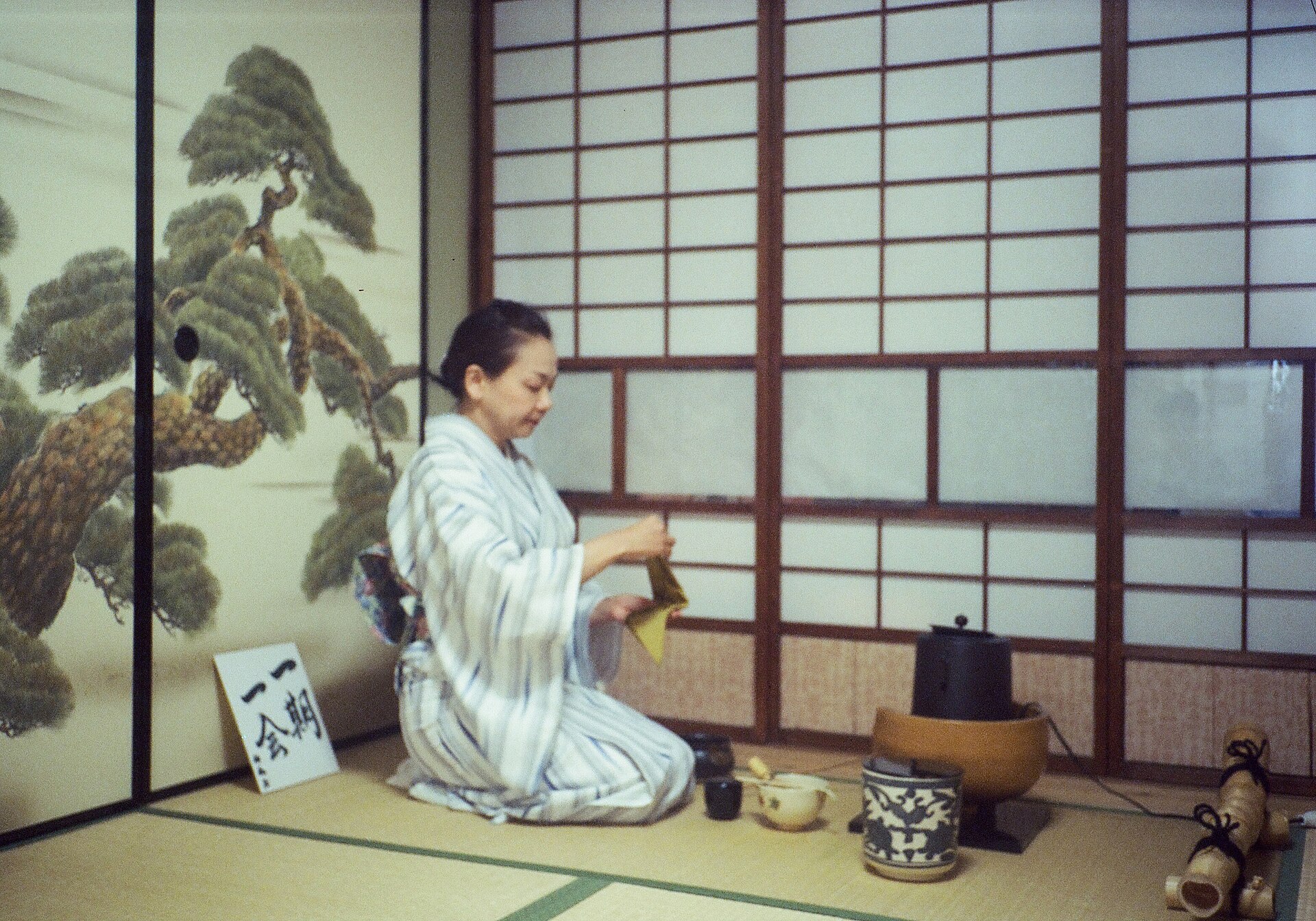
The Japanese tea ceremony is a ritual of preparing and serving powdered green tea, called matcha, in a quiet room. It looks simple, but everything in it is chosen with care: the bowl, the scroll hanging in the alcove, the sweets, even the way the host moves. For a first-time visitor, it’s one of the best ways to slow down in Japan, and Kyoto is the easiest place to try it.
What the tea ceremony is
The tea ceremony was originally called chanoyu, meaning “hot water for tea.” The word do, or “way,” was added in the 17th century. It’s now usually called sado or chado; the Urasenke school says chado, and most others say sado. The point is the shared moment between host and guest, and the utensils, the scroll and the room are meant to work together as a single whole. Today it nearly always means matcha, although there’s also a separate tradition built on loose-leaf tea, sencha-do, which developed in the Edo period.
Thick tea and thin tea
Matcha is served in two ways. Thick tea, koicha, is made with more powder and less water and is kneaded, not whisked, so it has no foam. Thin tea, usucha, is whisked until it’s frothy. Koicha is considered the main tea of a formal gathering, and usucha is the lighter and simpler one, which is what most visitors are served at a short ceremony.
Formal and informal gatherings
A chaji is the full, formal tea gathering, and it always includes a meal in the kaiseki style. A chakai is a less formal gathering, and today the word often means a large event where several tea rooms are set up and as many as a thousand guests pass through in a day. The host is the teishu, and the main guest, who sits first and speaks for the group, is the shokyaku.
A short history
In the 15th century the shogun Ashikaga Yoshimasa’s tea master, Murata Juko, banned gambling and drinking at tea gatherings and argued that the point was a spiritual exchange between host and guest. That’s the root of wabi-cha, a tea of simplicity. The oldest surviving tea room in the shoin style, a plain four-and-a-half-mat room called Dojinsai, was built at Yoshimasa’s retreat in Higashiyama. Wabi-cha was refined by Takeno Joo and completed by his pupil Sen no Rikyu (1522 to 1591) in the late 16th century. Rikyu’s motto was wa-kei-sei-jaku: harmony, respect, purity and tranquility. His descendants still lead the three Sen schools of tea. Rikyu served Toyotomi Hideyoshi, who ordered him to take his own life in 1591, and historians still debate why.
Ichigo ichie
The phrase ichigo ichie comes from the tea ceremony. It means that each gathering is a once-in-a-lifetime meeting and should be treated that way by both host and guest, and it’s traditionally attributed to Rikyu. You may see it written on a scroll in the tea room.
How to join a tea ceremony in Kyoto
Many tea houses and cultural centers in Kyoto run short ceremonies for visitors, often about an hour, with an explanation in English. Book ahead, since small rooms fill quickly, and ask if you’ll sit on tatami or on chairs. Wear socks, since you’ll remove your shoes, and avoid strong perfume. Let the host guide you: you’ll usually be given a sweet first, then the tea, and you’ll be shown how to hold and turn the bowl. If you’d like something more formal, such as a chaji with a meal, a private arrangement through a guide is the way to do it. See our guides to Kyoto and Kanazawa, and our Japan tour packages.
Planning a tea ceremony with Absolute Asia Tours
Absolute Asia Tours has planned private trips in Asia since 1989. For a tea ceremony that means a private booking with a host who speaks English, a guide who can explain what you’re seeing, and timing that fits your Kyoto days. We’re rated 4.8 out of 5 across about 900 traveler reviews. Have a look at our Japan tours or tell us your dates.
Sources (read in Japanese): Japanese Wikipedia entries on the tea ceremony (sado), Sen no Rikyu and ichigo ichie. Last checked November 2026.
Japanese tea ceremony: FAQ
What is the difference between koicha and usucha?
Koicha is thick tea, kneaded without foam. Usucha is thin tea, whisked into foam. Visitors are usually served usucha.
Who created the Japanese tea ceremony?
Its roots go back to Murata Juko in the 15th century. Sen no Rikyu (1522 to 1591) completed the style called wabi-cha.
What does ichigo ichie mean?
That each meeting happens only once, so host and guest should give it their full attention.
What is the difference between a chaji and a chakai?
A chaji is the formal gathering and always includes a kaiseki meal. A chakai is less formal and can be very large.
Is sado or chado correct?
Both. The Urasenke school says chado, and most other schools say sado.
Where can you try a tea ceremony as a visitor?
In Kyoto, where many tea houses run short ceremonies with English explanation. Book ahead.
Photo: Atticus nguyen, Wikimedia Commons, CC BY-SA 4.0.

The oldest surviving tea room in the shoin style, a plain four-and-a-half-mat room called Dojinsai, was built at Yoshimasa’s retreat in Higashiyama.
Further Reading
Journeys That Go There