Absolute Asia/Destinations/South Korea/Places to Visit/Guilin
Private & Tailor-Made South Korea Tours
Private Journeys in Guilin
The Essence of Guilin
Our expert guides to exploring Guilin Written by our specialists from their own experiences of visiting Guilin, these guides will help you make the most of your time there.
Along the Li River, the landscape does not hold still — it drifts into mist, then returns as though it never left.
Best Time to Visit: April – October
Known For: Li River scenery, karst peaks, Longji Rice Terraces, and quiet village life
Best Experience: Early mornings on the river before the crowds arrive
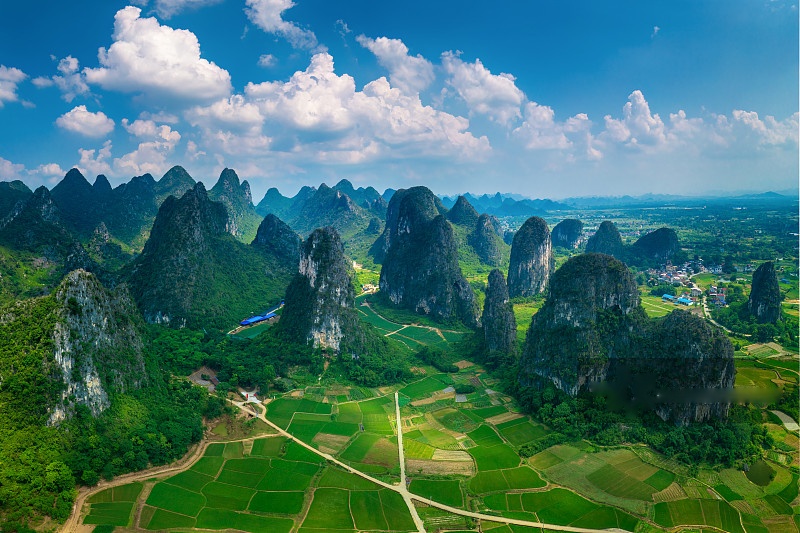
The Li River does not announce itself. It simply appears — silver and still in the early morning light, framed by limestone peaks that rise so abruptly from the valley floor they seem less like mountains and more like shapes someone painted into the mist.
We arrived before the tour boats did. That decision changed everything.
In those first quiet hours, Guilin belongs to fishermen and fog. Cormorant birds perch on the prows of narrow bamboo rafts while their owners untangle fishing nets in unhurried silence. Water buffalo stand knee-deep at the river’s edge, entirely indifferent to the mist curling around their legs.
“Chinese poets have been writing about this landscape since the Tang Dynasty. Standing here, it becomes easy to understand why they never quite found the right words.”
Thousands of karst peaks — each shaped differently by millions of years of rain and slow erosion — fade in and out of low cloud like mountains practicing disappearance.
There is no drama in it. Just patience.
Guilin’s dramatic limestone scenery forms part of the wider UNESCO-listed South China Karst landscape, recognized for some of the world’s most extraordinary karst formations.
The Countryside Beyond the River
The land between Yangshuo and Xingping rewards those willing to leave the main road behind.
Cycling through villages where elderly women sell pomelos beneath faded umbrellas, where children chase each other across old stone bridges, and where the smell of wood smoke drifts from farmhouse kitchens — this is where Guilin reveals something the famous viewpoints cannot: the texture of ordinary life carried quietly beneath extraordinary scenery.
One afternoon, a summer storm moved fast across the valley near the Yulong River. Within minutes, the mountains vanished entirely behind a white curtain of rain.
Inside a small riverside café, strangers sat together watching the landscape disappear. Nobody spoke much. Nobody needed to.
“Some places teach you to be still. Guilin is one of them.”
The Longji Rice Terraces
High in the mountains north of Guilin, the Longji Rice Terraces reveal a different dimension of southern China’s landscape — and of the people who shaped it.
Built by local Zhuang and Yao communities over seven centuries, the terraces curve across the mountainsides like enormous green waves frozen mid-motion.
This is not simply an agricultural feat. It is the record of generations who learned to read the land, transform its resistance into beauty, and sustain that beauty long after the hands that built it were gone.
Walking the narrow paths between wooden villages early in the morning — cloud still drifting through the valley below, smoke rising from kitchen fires above — feels less like tourism and more like stepping carefully into someone else’s rhythm of life.
One local woman invited us into her home one morning, offering oil tea brewed slowly over an open fire. We shared almost no common language.
The silence, somehow, felt entirely comfortable.
The Small Details That Stay Longest
Guilin’s strongest memories come from very small moments: watching cormorant fishermen stand perfectly still at dusk; hearing bicycle wheels echo softly through village roads at sunrise; drinking warm osmanthus tea while fog moves quietly between the peaks.
Even the food feels connected to the landscape. Local Guilin rice noodles — served in rich broth with pickled vegetables, peanuts, fresh herbs, and chili oil — are best eaten at small street stalls before the city fully wakes.
Simple food. Unpretentious. Yet somehow, in the right light and the right morning quiet, deeply atmospheric.
Practical Notes
- Best Season: April to October. Early summer mornings often bring the most atmospheric mist.
- Li River Cruise: The journey from Guilin to Yangshuo takes 4–5 hours. Early departures offer the quietest scenery.
- Xingping Village: Quieter and more atmospheric than central Yangshuo. Worth staying overnight.
- Longji Terraces: A separate day trip from Guilin, approximately 2.5–3 hours away by road.
- Local Food: Guilin rice noodles are the city’s most iconic dish and are best experienced early at local street stalls.
For travelers wanting to experience the region more deeply, our Essence of Guangxi: Karst Landscapes & Traditions journey combines the Li River, Yangshuo countryside, Longji Rice Terraces, and traditional village life at a slower and more meaningful pace.
Guilin is not a place to be conquered or checked off. It asks for something different — a slower pace, a willingness to sit with uncertainty, and to watch a mountain vanish into mist without needing to chase it back.
The travelers who leave most changed are rarely those who saw the most. They are the ones who stayed long enough to actually look.
At Absolute Asia Tours, we believe Guilin reveals itself most beautifully in quieter moments: drifting along the Li River before sunrise, lingering in hidden villages beyond Yangshuo, and allowing the landscape to unfold slowly rather than rushing past it.
The Private Difference
Tailor-Made Guilin Journeys
Absolute Asia crafts completely tailor-made, 100% private luxury journeys across South Korea. Guided by certified English-speaking scholar specialists, experience private after-hours access to Changdeokgung's Secret Garden, private hanbok fittings in Bukchon, high-speed KTX First Class rail to the ancient Silla capital of Gyeongju and coastal Busan, and stays at premier properties including Four Seasons Hotel Seoul and Signiel Busan.
Destination Quick Facts
| Ideal Duration | 7 – 12 Days (or 14 – 18 Days combined with Japan) |
| Best Season | Apr – May (Cherry Blossom Season & Mild Spring), Sep – Nov (Crisp Skies & Spectacular Autumn Foliage) |
| Typical Budget | $550 – $1,200+ per guest / day (Private executive vehicle & chauffeur, KTX First Class, certified bilingual guide, 5-star luxury hotels & domestic flights) |
| Travel Style | 100% Private, Tailor-Made Cultural Immersion & Contemporary Luxury |
| Best For | UNESCO Royal Palaces & Hanok Villages, Haute Korean Gastronomy & Michelin Dining, High-Speed KTX Rail, Contemporary Art & Architecture, Coastal Temples & Volcanic Jeju |
Our Favorite Journeys
Suggested itineraries featuring Guilin
Our itineraries will give you suggestions for what is possible when you travel in Guilin, and they showcase routes we know work particularly well. Treat them as inspiration, because your trip will be created uniquely by one of our specialists.
We are composing new Guilin itineraries right now. Tell us what you have in mind and a designer will build one around you.
Transparent Pricing Intelligence
What Does a Private Guilin Tour Cost?
South Korea combines ultra-modern infrastructure with deep dynastic traditions. Every Absolute Asia journey includes dedicated private executive vehicles and chauffeurs, KTX First Class bullet-train seating with luggage forwarding, licensed bilingual cultural guides, curated royal dining, and vetted 5-star luxury accommodations.
$550 – $750 per guest / day
Premier 5-star international hotels (The Shilla Seoul, Grand Josun Busan), private chauffeured touring, KTX First Class bullet-train tickets, licensed English-speaking guide, and curated palace admissions.
- 5-star luxury city and beach hotels
- Dedicated private executive sedan or minivan and chauffeur
- Licensed bilingual cultural guide throughout touring days
- Reserved KTX First Class bullet-train tickets between cities
- All curated palace admissions, hanbok experience & tea tastings
$800 – $1,350 per guest / day
World-class properties (Four Seasons Hotel Seoul, Signiel Busan) combined with authentic luxury hanok suites (Rakkojae Bukchon), private royal court dinner prepared by an intangible cultural heritage chef, and private DMZ tour.
- Luxury suites at Four Seasons Seoul and Signiel Busan
- Exclusive private hanok stay with cypress baths and traditional ondol heating
- Private VIP Korean culinary masterclass with a master chef
- Private chauffeured touring of the DMZ with exclusive access permissions
- 24/7 dedicated bilingual travel concierge & airport fast-track
$1,450 – $2,600+ per guest / day
The pinnacle of Korean luxury: Presidential suites, JW Marriott Jeju Resort & Spa clifftop villas, private helicopter volcano tours, after-hours private viewing of UNESCO royal tombs, and Michelin 3-star culinary dining.
- Top-tier executive suites and clifftop private villas in Jeju
- Private helicopter transfers and coastal aerial touring
- Private opening of National Treasure temple halls with resident Buddhist monks
- Private yacht charters on Haeundae Bay in Busan
- Unrestricted bespoke dining reservations and private sommelier pairings
What Drives Your Total Investment?
- Peak spring sakura (early April) and autumn foliage (October–November) hotel demand
- Boutique luxury hanok residences have very few rooms (3–5 suites per property)
- Dedicated private executive Mercedes van vs KTX high-speed rail combinations
- Flight hops to Jeju Island (Gimpo to Jeju GMP ⇄ CJU) during holiday periods
Local Operational Realities
What You Need to Know Before Traveling in Guilin
KTX High-Speed Bullet Rail & Door-to-Door Luggage Courier
South Korea's KTX bullet train network connects Seoul to Gyeongju in 2 hours and Busan in 2.5 hours at speeds exceeding 300 km/h. To ensure seamless comfort, Absolute Asia coordinates luggage forwarding between city hotels so you board KTX First Class with only daypacks.
Hanok Heritage Living vs. Modern 5-Star Luxury
Traditional Korean hanok homes feature low furniture, paper screen doors, and ondol (underfloor heating). While deeply atmospheric, staying exclusively in hanoks for a whole week can feel rustic. Absolute Asia recommends pairing 1–2 nights in a restored luxury hanok (like Rakkojae) with modern 5-star sanctuaries (Four Seasons Seoul).
Seoul Urban District Pacing & Chauffeur Logistics
Seoul is a massive metropolis divided by the Han River. Transit between northern historical districts (Jongno, Bukchon, Insa-dong) and southern modern hubs (Gangnam, Apgujeong) can be slow during peak traffic. Absolute Asia sequences touring by geographic clusters, maximizing time spent exploring rather than sitting in traffic.
Dining Customs & Dietary Accommodations
Traditional Korean meals emphasize shared banchan dishes, barbecued meats, and broths prepared with garlic, fermented paste, and anchovy stock. Our private concierges coordinate dietary restrictions with chefs in advance to accommodate vegetarian, gluten-free, or pescatarian preferences without sacrificing authentic flavors.
Handpicked 5-Star Sanctuaries
Signature Stays & Exclusive Experiences in Guilin
Four Seasons Hotel Seoul
Contemporary Korean luxury overlooking Gyeongbokgung Palace, featuring an authentic Korean bathhouse, Michelin dining, and the Charles H. speakeasy.
Signiel Seoul
Perched between floors 76 and 101 of the landmark tower, offering panoramic skyline vistas over Seoul and the Han River, with Michelin-starred dining.
Signiel Busan
Luxury oceanfront suites in the LCT Tower overlooking Haeundae Beach, featuring outdoor infinity pools, private cabanas, and retreat spa sanctuaries.
Rakkojae Seoul Bukchon
A 130-year-old aristocratic hanok residence restored by a human national treasure, featuring traditional wooden architecture, mud saunas, and private tea pavilions.
JW Marriott Jeju Resort & Spa
Bill Bensley-designed clifftop sanctuary blending Jeju volcanic stone with modern luxury, overlooking the dramatic southern coast and Olle trails.
The Shilla Seoul
Distinguished Korean grande dame featuring traditional sculpture gardens, the 3-Michelin-star Korean restaurant La Yeon, and Urban Island pool cabanas.
Tailored to Your Style
Family & Honeymoon Journeys in Guilin
Private South Korea Family Adventures
An exciting, high-energy journey for families: explore Gyeongbokgung Palace dressed in bespoke royal hanbok, learn choreographed dance moves in a private K-pop studio, ride 300 km/h KTX bullet trains to Busan, walk across the glass sky bridge 500 meters up Lotte World Tower, and explore ancient royal burial mounds in Gyeongju.
- Private hanbok fitting and photographer-escorted exploration of royal Joseon palaces
- Interactive K-pop dance and vocal masterclass with professional entertainment trainers
- High-speed KTX First Class bullet-train rides across the Korean peninsula
- Private hands-on kimchi making and Korean barbecue culinary masterclasses
- Family-friendly coastal yacht cruises and beach fun along Busan's Haeundae shoreline
Romantic Korea & Jeju Island Escapes
An intimate, sophisticated romantic getaway: stay in a private luxury hanok with traditional cypress hot tubs, take part in an exclusive tea ceremony in Bukchon, enjoy private sunset champagne cruises along Busan's illuminated Diamond Bridge, and retreat to a secluded private pool villa on volcanic Jeju Island.
- Exclusive private hanok suite stays with traditional ondol comfort and wooden courtyards
- Couples' Korean traditional spa rituals featuring red ginseng, jade stone, and hydrotherapy
- Private candlelit dinners at Michelin-starred Korean contemporary dining rooms
- Private sunset yacht charters on Haeundae Bay with champagne and coastal vistas
- 24/7 dedicated private chauffeur and concierge managing all reservations and VIP entries
Cross-Border Extensions
Seamless Multi-Country Extensions Beyond Guilin
Connect multiple Asian cultures into one coherent private journey with expert in-country concierge coordination.
Japan & South Korea: East Asia Cultural Icons
Tokyo → Hakone → Kyoto → Osaka → Seoul → Busan
Short 2-hour non-stop flight connecting Osaka Kansai (KIX) or Tokyo Haneda (HND) to Seoul Incheon (ICN) / Gimpo (GMP).
When to Go
The premier seasons to visit South Korea are spring (April to May) for the cherry blossoms and pleasant spring warmth, and autumn (September to November) for crisp blue skies, low rainfall, and breathtaking autumn colors across national parks and palaces.
Winter (December to February) is crisp and snowy, ideal for hot stews, Korean saunas (jjimjilbang), and quiet palace strolls.
Month by Month
South Korea Through the Seasons
Cherry Blossom Spring (Beotkkot)
Delicate pink blossoms across Yeouido and Gyeongju; pleasant mild weather perfect for palace gardens and outdoor walks.
Summer Energy & Coastal Busan
Lush green mountains, vibrant summer beach festivals in Busan, and refreshing coastal breezes on Jeju Island.
Crisp Autumn Foliage (Danpung)
Spectacular crimson maples and golden gingko trees across Seoul palaces, Gyeongju tumuli, and Mount Seorak.
Winter Dynasties & Warm Saunas
Crisp winter skies, snow-covered royal roofs, steaming Korean bathhouse rituals, and quiet cultural touring.
Frequently Asked Questions
Private Travel to Guilin: Essential Advice
Verified Traveler Stories
Recent Guest Experiences in Guilin
“Our private tour through Seoul, Gyeongju, and Busan with Absolute Asia was flawless. Our guide, Min-jun, brought Korean royal history to life at Gyeongbokgung and took us to private artisan studios in Bukchon that we never would have discovered alone. Four Seasons Seoul and Signiel Busan were both magnificent.”
“Combining the high-speed KTX train with luggage forwarding was a masterstroke—we traveled so easily between Seoul and Busan. The private street food tour in Gwangjang Market and our stay at Rakkojae hanok were the highlights of our East Asia trip.”

Start Planning
Ready to see Guilin on your own terms?
Share a few details and a private travel designer will reach out within one business day.