Absolute Asia/Destinations/South Korea/Places to Visit/Datong
Private & Tailor-Made South Korea Tours
Private Journeys in Datong
The Essence of Datong
Our expert guides to exploring Datong Written by our specialists from their own experiences of visiting Datong, these guides will help you make the most of your time there.
Datong is a city in northern Shanxi, near the borders with Hebei and Inner Mongolia, and it was the capital of the Northern Wei dynasty from 398 until 494. That history left it the Yungang Grottoes, and the region around it holds two more landmarks, the Hanging Temple and the Wooden Pagoda of Yingxian. Travelers usually come on the way between Beijing and Pingyao or Xi’an.
| Yungang Grottoes | carved mainly 453 to 495; 51 main caves, over 1,100 niches and over 51,000 statues; UNESCO World Heritage since 2001 |
|---|---|
| Largest figure and cave | tallest Buddha 17 m; Cave 6, the largest, is about 20 m high |
| Hanging Temple | in Hunyuan County; 40 rooms propped by 27 wooden beams, about 90 m above the valley floor; national protected site since 1982 |
| Wooden Pagoda of Yingxian | begun 1056; 67.31 m, the oldest surviving wooden pagoda in China |
| Northern Wei capital | 398 to 494, when the court moved to Luoyang |
Yungang Grottoes
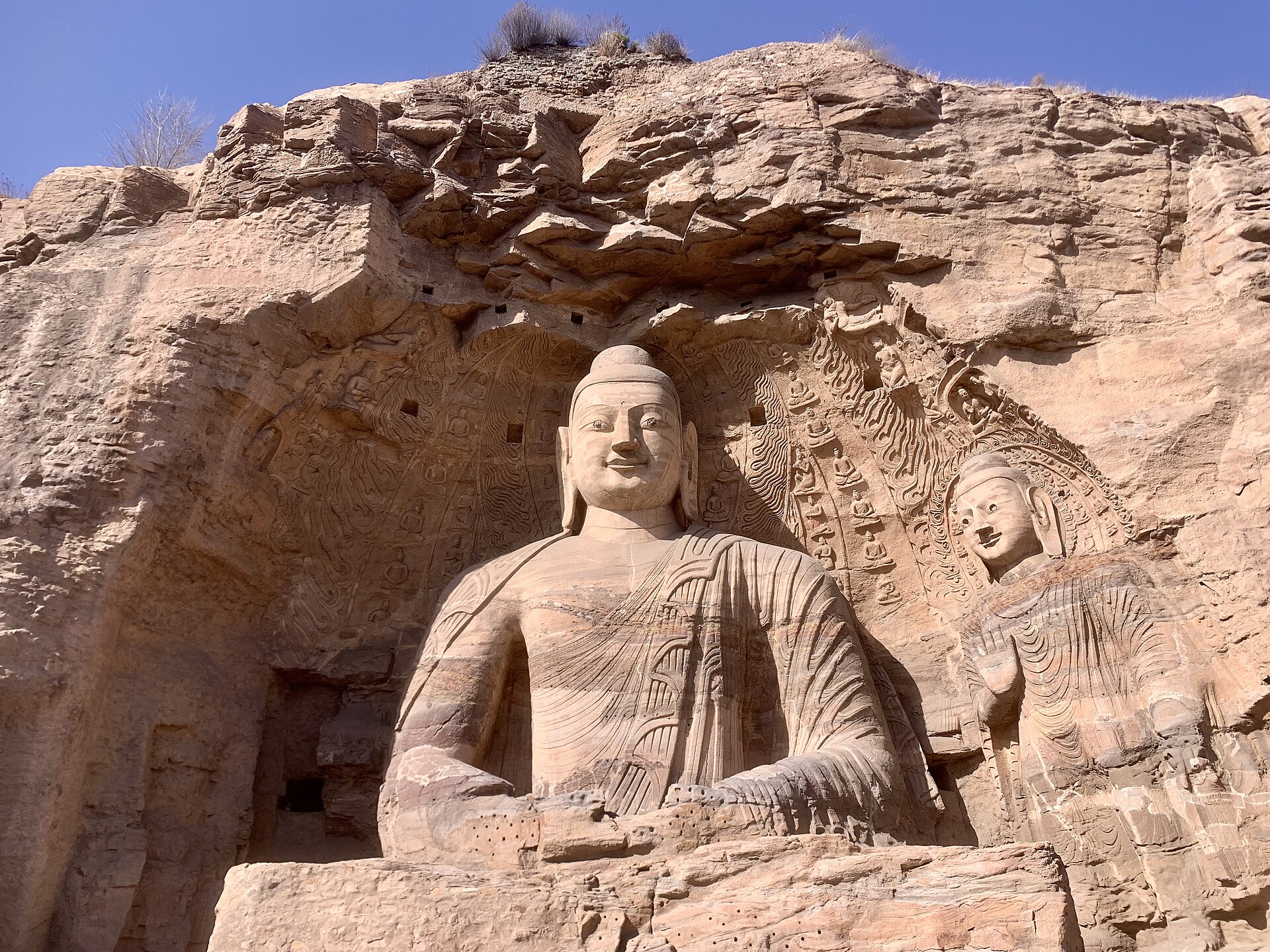
The grottoes lie at the foot of Wuzhou Mountain, about a kilometer of cliff on the north bank of the Wuzhou River. Work began in 453, and Chinese Wikipedia describes them as the first large grotto complex in China organized by the imperial court. The monk Tanyao asked in 460 to carve five caves, now numbered 16 to 20 and known as the Tanyao Five Caves, which are the earliest and grandest of the group. The caves split into east, middle and west sections. Early figures show Gandharan and Gupta influence, with fuller faces and high topknots. Under Emperor Xiaowen the style became more Chinese, with clothing closer to that of southern court officials. Carving slowed after the capital moved to Luoyang in 494. The site became a national protected site in 1961 and a World Heritage Site in 2001.
Hanging Temple
The Hanging Temple is built into a recess in a cliff in Hunyuan County, with its highest point about 90 meters above the valley floor. Twenty-seven wooden beams, about 50 centimeters thick and soaked in tung oil, are set into the rock and carry much of the structure, and a channel cut in the rock above diverts falling stones. It has 40 rooms linked by corridors and walkways, and shrines to Confucius, Laozi and the Buddha sit together at the highest point. Accounts of its founding differ, and one dates it to 491, but the buildings you see are from the Ming and Qing dynasties. Narrow walkways limit how many visitors enter at once, so expect queues at busy times.
Wooden Pagoda of Yingxian
Fogong Temple’s Sakyamuni Pagoda in Ying County, Shuozhou, is the oldest surviving wooden pagoda in China and was recognized by Guinness in 2016 as the world’s tallest wooden pagoda. It dates from 1056, stands 67.31 meters tall, and has five visible floors plus four hidden ones. It survived several earthquakes and shelling in 1926 and 1948. Repair plans were disputed from the 1970s until 2013. Check access before you go, since visits to the interior can be restricted.
Getting there and how long to stay
Datong sits on the rail line between Beijing and Taiyuan, and many travelers use it as a stop between Beijing and Pingyao or Xi’an. Give it one full day for the grottoes and the city, and a second for the Hanging Temple and the Wooden Pagoda, which lie to the south and east of the city. For the rest of the route, see our guides to Pingyao, Beijing and our China tours.
Planning Datong with Absolute Asia Tours
Absolute Asia Tours has planned private trips in Asia since 1989. For Datong that means a driver for the long hops between sites, a guide who can read the grotto art, and a hotel inside the walled city. We’re rated 4.8 out of 5 across about 900 traveler reviews. See our China tours or tell us your dates.
Sources (read in Chinese, Chinese Wikipedia): 云冈石窟, 悬空寺, 应县木塔, 大同市. Last checked November 2026.
Datong: FAQ
What is Datong famous for?
The Yungang Grottoes, a World Heritage Site, plus the Hanging Temple and the Wooden Pagoda of Yingxian in the surrounding region.
How many statues are at the Yungang Grottoes?
More than 51,000 statues in over 1,100 niches, across 51 main caves, carved mainly between 453 and 495.
How old is the Hanging Temple?
One account dates its founding to 491 under the Northern Wei, but the buildings you see were rebuilt in the Ming and Qing dynasties.
How tall is the Wooden Pagoda of Yingxian?
67.31 meters. It was begun in 1056 and is the oldest surviving wooden pagoda in China.
How many days do you need in Datong?
One full day for the grottoes and the city, and a second day for the Hanging Temple and the pagoda.
Photo: Dudva, Wikimedia Commons, CC0. Cave 20 at the Yungang Grottoes.

The Private Difference
Tailor-Made Datong Journeys
Absolute Asia crafts completely tailor-made, 100% private luxury journeys across South Korea. Guided by certified English-speaking scholar specialists, experience private after-hours access to Changdeokgung's Secret Garden, private hanbok fittings in Bukchon, high-speed KTX First Class rail to the ancient Silla capital of Gyeongju and coastal Busan, and stays at premier properties including Four Seasons Hotel Seoul and Signiel Busan.
Destination Quick Facts
| Ideal Duration | 7 – 12 Days (or 14 – 18 Days combined with Japan) |
| Best Season | Apr – May (Cherry Blossom Season & Mild Spring), Sep – Nov (Crisp Skies & Spectacular Autumn Foliage) |
| Typical Budget | $550 – $1,200+ per guest / day (Private executive vehicle & chauffeur, KTX First Class, certified bilingual guide, 5-star luxury hotels & domestic flights) |
| Travel Style | 100% Private, Tailor-Made Cultural Immersion & Contemporary Luxury |
| Best For | UNESCO Royal Palaces & Hanok Villages, Haute Korean Gastronomy & Michelin Dining, High-Speed KTX Rail, Contemporary Art & Architecture, Coastal Temples & Volcanic Jeju |
Our Favorite Journeys
Datong, at Its Best Right Now
We are composing new Datong itineraries right now. Tell us what you have in mind and a designer will build one around you.
Transparent Pricing Intelligence
What Does a Private Datong Tour Cost?
South Korea combines ultra-modern infrastructure with deep dynastic traditions. Every Absolute Asia journey includes dedicated private executive vehicles and chauffeurs, KTX First Class bullet-train seating with luggage forwarding, licensed bilingual cultural guides, curated royal dining, and vetted 5-star luxury accommodations.
$550 – $750 per guest / day
Premier 5-star international hotels (The Shilla Seoul, Grand Josun Busan), private chauffeured touring, KTX First Class bullet-train tickets, licensed English-speaking guide, and curated palace admissions.
- 5-star luxury city and beach hotels
- Dedicated private executive sedan or minivan and chauffeur
- Licensed bilingual cultural guide throughout touring days
- Reserved KTX First Class bullet-train tickets between cities
- All curated palace admissions, hanbok experience & tea tastings
$800 – $1,350 per guest / day
World-class properties (Four Seasons Hotel Seoul, Signiel Busan) combined with authentic luxury hanok suites (Rakkojae Bukchon), private royal court dinner prepared by an intangible cultural heritage chef, and private DMZ tour.
- Luxury suites at Four Seasons Seoul and Signiel Busan
- Exclusive private hanok stay with cypress baths and traditional ondol heating
- Private VIP Korean culinary masterclass with a master chef
- Private chauffeured touring of the DMZ with exclusive access permissions
- 24/7 dedicated bilingual travel concierge & airport fast-track
$1,450 – $2,600+ per guest / day
The pinnacle of Korean luxury: Presidential suites, JW Marriott Jeju Resort & Spa clifftop villas, private helicopter volcano tours, after-hours private viewing of UNESCO royal tombs, and Michelin 3-star culinary dining.
- Top-tier executive suites and clifftop private villas in Jeju
- Private helicopter transfers and coastal aerial touring
- Private opening of National Treasure temple halls with resident Buddhist monks
- Private yacht charters on Haeundae Bay in Busan
- Unrestricted bespoke dining reservations and private sommelier pairings
What Drives Your Total Investment?
- Peak spring sakura (early April) and autumn foliage (October–November) hotel demand
- Boutique luxury hanok residences have very few rooms (3–5 suites per property)
- Dedicated private executive Mercedes van vs KTX high-speed rail combinations
- Flight hops to Jeju Island (Gimpo to Jeju GMP ⇄ CJU) during holiday periods
Local Operational Realities
What You Need to Know Before Traveling in Datong
KTX High-Speed Bullet Rail & Door-to-Door Luggage Courier
South Korea's KTX bullet train network connects Seoul to Gyeongju in 2 hours and Busan in 2.5 hours at speeds exceeding 300 km/h. To ensure seamless comfort, Absolute Asia coordinates luggage forwarding between city hotels so you board KTX First Class with only daypacks.
Hanok Heritage Living vs. Modern 5-Star Luxury
Traditional Korean hanok homes feature low furniture, paper screen doors, and ondol (underfloor heating). While deeply atmospheric, staying exclusively in hanoks for a whole week can feel rustic. Absolute Asia recommends pairing 1–2 nights in a restored luxury hanok (like Rakkojae) with modern 5-star sanctuaries (Four Seasons Seoul).
Seoul Urban District Pacing & Chauffeur Logistics
Seoul is a massive metropolis divided by the Han River. Transit between northern historical districts (Jongno, Bukchon, Insa-dong) and southern modern hubs (Gangnam, Apgujeong) can be slow during peak traffic. Absolute Asia sequences touring by geographic clusters, maximizing time spent exploring rather than sitting in traffic.
Dining Customs & Dietary Accommodations
Traditional Korean meals emphasize shared banchan dishes, barbecued meats, and broths prepared with garlic, fermented paste, and anchovy stock. Our private concierges coordinate dietary restrictions with chefs in advance to accommodate vegetarian, gluten-free, or pescatarian preferences without sacrificing authentic flavors.
Handpicked 5-Star Sanctuaries
Signature Stays & Exclusive Experiences in Datong
Four Seasons Hotel Seoul
Contemporary Korean luxury overlooking Gyeongbokgung Palace, featuring an authentic Korean bathhouse, Michelin dining, and the Charles H. speakeasy.
Signiel Seoul
Perched between floors 76 and 101 of the landmark tower, offering panoramic skyline vistas over Seoul and the Han River, with Michelin-starred dining.
Signiel Busan
Luxury oceanfront suites in the LCT Tower overlooking Haeundae Beach, featuring outdoor infinity pools, private cabanas, and retreat spa sanctuaries.
Rakkojae Seoul Bukchon
A 130-year-old aristocratic hanok residence restored by a human national treasure, featuring traditional wooden architecture, mud saunas, and private tea pavilions.
JW Marriott Jeju Resort & Spa
Bill Bensley-designed clifftop sanctuary blending Jeju volcanic stone with modern luxury, overlooking the dramatic southern coast and Olle trails.
The Shilla Seoul
Distinguished Korean grande dame featuring traditional sculpture gardens, the 3-Michelin-star Korean restaurant La Yeon, and Urban Island pool cabanas.
Tailored to Your Style
Family & Honeymoon Journeys in Datong
Private South Korea Family Adventures
An exciting, high-energy journey for families: explore Gyeongbokgung Palace dressed in bespoke royal hanbok, learn choreographed dance moves in a private K-pop studio, ride 300 km/h KTX bullet trains to Busan, walk across the glass sky bridge 500 meters up Lotte World Tower, and explore ancient royal burial mounds in Gyeongju.
- Private hanbok fitting and photographer-escorted exploration of royal Joseon palaces
- Interactive K-pop dance and vocal masterclass with professional entertainment trainers
- High-speed KTX First Class bullet-train rides across the Korean peninsula
- Private hands-on kimchi making and Korean barbecue culinary masterclasses
- Family-friendly coastal yacht cruises and beach fun along Busan's Haeundae shoreline
Romantic Korea & Jeju Island Escapes
An intimate, sophisticated romantic getaway: stay in a private luxury hanok with traditional cypress hot tubs, take part in an exclusive tea ceremony in Bukchon, enjoy private sunset champagne cruises along Busan's illuminated Diamond Bridge, and retreat to a secluded private pool villa on volcanic Jeju Island.
- Exclusive private hanok suite stays with traditional ondol comfort and wooden courtyards
- Couples' Korean traditional spa rituals featuring red ginseng, jade stone, and hydrotherapy
- Private candlelit dinners at Michelin-starred Korean contemporary dining rooms
- Private sunset yacht charters on Haeundae Bay with champagne and coastal vistas
- 24/7 dedicated private chauffeur and concierge managing all reservations and VIP entries
Cross-Border Extensions
Seamless Multi-Country Extensions Beyond Datong
Connect multiple Asian cultures into one coherent private journey with expert in-country concierge coordination.
Japan & South Korea: East Asia Cultural Icons
Tokyo → Hakone → Kyoto → Osaka → Seoul → Busan
Short 2-hour non-stop flight connecting Osaka Kansai (KIX) or Tokyo Haneda (HND) to Seoul Incheon (ICN) / Gimpo (GMP).
When to Go
The premier seasons to visit South Korea are spring (April to May) for the cherry blossoms and pleasant spring warmth, and autumn (September to November) for crisp blue skies, low rainfall, and breathtaking autumn colors across national parks and palaces.
Winter (December to February) is crisp and snowy, ideal for hot stews, Korean saunas (jjimjilbang), and quiet palace strolls.
Month by Month
South Korea Through the Seasons
Cherry Blossom Spring (Beotkkot)
Delicate pink blossoms across Yeouido and Gyeongju; pleasant mild weather perfect for palace gardens and outdoor walks.
Summer Energy & Coastal Busan
Lush green mountains, vibrant summer beach festivals in Busan, and refreshing coastal breezes on Jeju Island.
Crisp Autumn Foliage (Danpung)
Spectacular crimson maples and golden gingko trees across Seoul palaces, Gyeongju tumuli, and Mount Seorak.
Winter Dynasties & Warm Saunas
Crisp winter skies, snow-covered royal roofs, steaming Korean bathhouse rituals, and quiet cultural touring.
Frequently Asked Questions
Private Travel to Datong: Essential Advice
Verified Traveler Stories
Recent Guest Experiences in Datong
“Our private tour through Seoul, Gyeongju, and Busan with Absolute Asia was flawless. Our guide, Min-jun, brought Korean royal history to life at Gyeongbokgung and took us to private artisan studios in Bukchon that we never would have discovered alone. Four Seasons Seoul and Signiel Busan were both magnificent.”
“Combining the high-speed KTX train with luggage forwarding was a masterstroke—we traveled so easily between Seoul and Busan. The private street food tour in Gwangjang Market and our stay at Rakkojae hanok were the highlights of our East Asia trip.”
Start Planning
Ready to see Datong on your own terms?
Share a few details and a private travel designer will reach out within one business day.